


From: civilwarhome.com
Source for this article: "The Medical and Surgical History of the War of the Rebellion. (1861-65.) Part III, Volume II, Chapter XV.--Transportation of the Wounded

The first removal of the wounded from the battle-field was generally effected by means of hand litters. The number of litters issued during the war exceeded fifty thousand(1) (50,000). From the Purveyor's Office at New York, Brigadier General R. S. Satterlee reports that from April 1, 1861, to August, 1865, sixteen thousand eight hundred and seven (16,807) hand litters were issued. At the Medical Purveyor's Depot at Louisville, from November, 1863, to August, 1865, seven thousand and ninety-eight (7,098) hand stretchers were issued, and Surgeon D. L. Magruder, U. S. A., estimated that four thousand seven hundred and thirty-two (4,732) had been given out before November, 1863. The Medical Purveyor's Office at Philadelphia issued, from January, 1863, to August, 1865, five thousand five hundred and forty-eight (5,548), and the Office at New Orleans, from September, 1864, to the end of the war, eight hundred and thirty-five (835) stretchers.
In the beginning of the war the Satterlee, or U. S. Regulation litter (FIG. 436), was supplied to the regiments. It weighed twenty-four and one-half pounds and was twenty-seven inches wide. The canvas consisted of two pieces, five feet ten inches long, sewed in the centre with a flat seam, and with a hem on either side seven and one-half inches wide, through which the poles were passed; there was an inch and a half hem on each end; on one end were three tarred rope loops to put over the pins on the cross-bar,
The Records of the Property Division of the Surgeon-General's Office show that from 1861 to 1865 fifty-two thousand four hundred and eighty-nine (52,489) litters of various manufacture were purchased and issued to the troops.
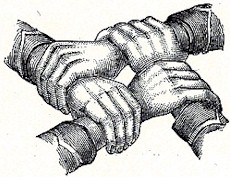
Extemporaneous modes of conveying wounded from the field of baffle can only be briefly alluded to. Stout sticks or muskets may be passed through the sleeves of a coat, or rolled into the edges of blankets and a litter thus be formed. Hurdles, gates, or ladders, with blankets or straw thrown over them, have made useful stretchers. Poles interlaced with ropes or telegraph wire have been found to answer the purpose of a litter. The editor was once obliged to transport a soldier, wounded in the abdomen, a distance of twelve miles along the narrow bed of a creek filled wit h boulders and obstructions: "I was fortunate enough to find two ash saplings which, with a blanket stretched across, made an improvised litter, on which my patient was borne by relays of men with comparative ease and comfort. At another time a man belonging to a small detachment sent out from a scouting party was wounded in the leg by the accidental discharge of a musket. Finding it impossible to place the man on horseback, and unsafe to detach a small party to seek the mare command, his comrades carried him a distance of about three miles by forming a seat with their bands and arms similar to the chairs made by children in their games (Fig. 437). During the late war I saw a soldier who had been wounded at some distance from his command conveyed to a place of safety by laying him prone across a saddle, the stirrup of one side being sufficiently lengthened to afford support for one foot. The horse with his burden was then led quite a distance. I am familiar with another instance where a man, badly wounded, was conveyed about a three-days' journey in a cot or hammock framed by securing a blanket to two lariat ropes; the ends of the ropes were gathered and carried by his comrades on horseback. All military surgeons know of instances where wounded men have been carried from the battle-field on muskets with an overcoat laid upon them for a bed. Under the urgent demands of neccessity the fruits of ingenuity are sure to come to the rescue." (See Circular No. 9, On the Transport of Sick and Wounded by Pack-Animals, Washington, 1877, p. 27.)
and two five-inch drilling loops for pulling the canvas over the poles; at the other end were three eyelet-holes, with a piece of rope three feet long and spliced into one of the holes for fastening the canvas to the pins on the other cross-bar. The poles were made of seasoned red ash, were one and one-half inches in diameter and eight feet nine inches long. Sixteen inches from either end of the poles were wrought-iron bands three-sixteenths of an inch thick and three-fourths of an inch wide, and riveted to the poles as shoulders for the cross-bars to strike against. The cross-bars weighed six and one-fourth pounds; they were made of seasoned white ash, one and one-half inches thick by twenty-four inches long. A piece of wrought-iron, six feet long by one inch wide and one-fourth of an inch thick, was so curved as to form the legs(1) and sockets on either end of the wooden cross-bar for the poles to pass through, and was fastened by two rivets, one at each end; the pin in the centre, on which the canvas was looped, was used as a third. The three pins in each cross-bar were made of half-inch iron, and projected one inch, with heads to keep the loops from slipping off. The shoulder straps weighed one and one-half pounds, were made of leather two inches wide, five feet eight inches long, with a three and one-half inches loop at one end and a buckle at the other end for adjustment on the handles of the stretcher. One objection to the Satterlee litter was its bulk, which seriously interfered with its conveyance in large numbers.

The Halstead litter, a stretcher of lighter and more compact pattern (FIG. 438), soon superseded the Satterlee. It weighed twenty-three and three-fourths pounds and was twenty-three and one-half inches wide; the length of the canvas (unbleached) was five feet eleven inches, being fastened on the outer side of t he rave with six-ounce tacks. The poles were made of seasoned white ash, eight feet long and one and five-sixths inches square, with thirteen inches at one end and twelve inches at the other, extending beyond the canvas, and rounded off for handles. The legs, which were also made of seasoned white ash, were fourteen and one-half inches long, one inch thick, one and seven-eighths inches wide at the top, and tapering to one and three-eighths inches at the bottom. They were fastened to the poles with screw bolts, washers under the heads of the bolts, and rivets through the upper end of the legs to prevent them from splitting. The braces to hold the stretcher open, one (on the under side) at either end, consisted of two pieces of wrought-iron one inch wide by three-eighths of an inch thick; one piece was fifteen inches and the other twelve inches in length, hinged in the centre of the stretcher, the longer one overlapping the shorter three and one-half inches, and, when open, shutting on a bolt or pin, forming a stiff shoulder for the hinge and preventing the stretcher from accidentally closing. The braces were fastened on with heavy screws, with pieces of common hoop iron underneath the braces to prevent them from wearing the wood. The shoulder straps weighed eight ounces, and were made of striped cotton webbing two and one-half inches wide by fifty inches long, with a five-inch loop at one end and a leather strap twenty-two and one-half inches long by one and one-sixth inches wide, with buckle, at the other end to loop around the handles of the stretcher at any length desired. A hair pillow covered with canvas accompanied this stretcher, which
Professor LONGMORE in his Treatise on the Transport of Sick and Wounded Troops, London, 1869, p. 129, has probably mistaken the iron feet for yoke pieces, as he speaks of the absence of feet in the litter.
In the preliminary report, Circular No. 6, S. G. O., 1865, p. 81, this litter is erroneously called the Smith hand litter; the litter there designated as the Halstead litter was a stretcher issued by the Sanitary Commission. It is to be regretted that these errors have misled Professor LONGMORE, who in his excellent Treatise on the Transport of Sick and Wounded Troops, p. 141, reproduced the wood-cuts from Circular No. 6.
gave great satisfaction, and out of the litters (16,807) issued by the New York Purveying Depot twelve thousand eight hundred and sixty-seven (12,867) were of this pattern.
Of the litter shown in FIG. 439 and known in New York as the Sanitary Commission litter, few were issued; it was too fragile for the hard usage of actual warfare. A drawing of the litter used in the Confederate armies is shown in FIG. 440, and has been copied from Chisolm.(1) Its construction was very simple and, with the exception of the mode of securing the duck cloth, or sacking, to the frame, needs no explanation. "A groove three-quarters of an inch wide and five-eighths of an inch deep is cut out in the length of the frame. The cloth is tacked in this and secured by a lath which fits accurately the groove and which is nailed in, covering the cloth. The tension upon the cloth is not borne by the tacks, but is uniformly supported by the entire lath, and therefore never rips off."
A litter to be used as a bedstead was proposed by Assistant Surgeon Henry S. Schell, in 1862, in a letter to Medical Inspector Vollum, U. S. A.: "I beg leave to suggest that the hand litter at present in use be somewhat modified, so that it may be arranged as a bedstead in the hospital tent when it is desirable to have a large number of beds quickly made up. It generally takes a day, perhaps more, to prepare bedsteads, or rather to build them, so that they may be elevated from the damp and uneven surface of the ground. The present stretcher cannot be used to make two rows of beds, with a passage from door to door between them in the usual manner, because of its length. The litter (FIGS. 441, 442) which I would propose is constructed of two parallel bars, each six feet two inches long, connected by a strong canvas, and separated by a jointed iron rod about six or eight inches from each end, somewhat similar to those on the litter now in use. To the ends of each of the parallel wooden bars a shorter one, ten inches long, is joined by a strong hinge placed underneath. This latter bar constitutes the handle when used as a stretcher, or the leg when used as a camp bedstead. It is retained in the upright position by a short iron stay, as seen in the figure. I have long felt the want of such an arrangement when arriving in camp and wishing to pitch the hospital tent immediately. The hinge will be found to last much longer than the canvas. As each ambulance carries two stretchers, a hospital may be improvised from these very readily."
In the last year of the war an order was issued for the construction of a form of litter on wheels (FIG. 443), similar to one used advantageously in the Danish war of 1864, but there are no reports that indicate its practical utility.
The modes of carrying wounded men on horse or mule litters during the war have been fully described in Circular No. 9, Surgeon General's Office, March 1, 1877, and we cannot do better than to reproduce, with a few additional remarks, the account given there by the author, the late Surgeon George A. Otis, U. S. Army:
"In the Revised Regulations for the Army of the United States for 1861, Paragraph 1298 reads: 'Horse litters may be prepared and furnished to posts whence they may be required for service on ground not admitting the employment of two-wheeled carriages; said litters to be composed of a canvas bed similar to the present stretcher, and of two poles, each sixteen feet long, to be made in sections, with head and foot pieces constructed to act as stretchers to keep the poles apart.' There is no record that these litters were used during the war.
"During the progress of the late war in this country a number of persons, actuated by motives of patriotism, humanity, or interest, devised and brought to the notice of the War Department forms of conveyance for the sick and wounded in localities impracticable for wheeled vehicles, that were represented as improvements upon existing patterns. Several of these were apparently suggested by the descriptions of Delafield(3) and McClellan(4) of the horse litters and cacolets they had observed in the Crimea. In October, 1861, W. C. H. Waddell forwarded to Secretary Cameron a proposal to construct cacolets and litters for army use, accompanied by drawings (FIGS. 446, 447)
Professor T. LONGMORE, in his excellent Treatise on the Transport of Sick and Wounded Troops, London, 1869, p. 292, thus refers to this form of litter: "It is necessary to notice another form of sick-transport litter issued for use in the early part of the late war in the United States, in which, instead of two litters being suspended across one horse or mule, one litter was suspended between two horses. This is a very ancient form of litter in Europe. Frequent notices of it occur, showing its common use on occasions of state and ceremony, as well as its employment for the carriage of sick persons, in the records of our own country prior to the introduction of coaches. It seems curious that its use should have been revived in modern times in America." In a note it is added: "This form of litter is referred to as late as the reign of Charles II. A quotation introduced into the first volume of Knight's London, pp. 24 and 25, mentions that 'Major General Skipton, coming in a horse.litter to London when wounded, as he passed by the brew house near St. John street, a fierce mastiff flew at one of the horses and held him so fast that the horse grew mad as a mad dog: the soldiers were so amazed that none had the wit to shoot the mastiff; but the horse-litter, berne between the two horses, tossed the major-general like a dog in a blanket.'"
Report on the Art of War in Europe in 1854, 1855, and 1856, by Major RICHARD DELAFIELD, Corps of Engineers, from his Notes and Observa-Siena made as a member of a "Military Commission to the Theatre of War in Europe," Washington, 1860.
copied from Delafield's report, and suggested some trivial modifications. In November, 1861, Mr. G. Kohler offered to furnish mule litters and chairs of patterns imitated from those used in the Crimea. In July, 1862, three hundred of these litters were purchased. In April, 1862, Surgeon Glover Perin, U. S. A., and Assistant Surgeon Benjamin Howard, U. S. A., reported to Surgeon General C. A. Finley the results of their inspection of cacolets and litters devised by Mr. Charles Proal, of Louisville.(1) Newspaper descriptions, almost textually quoted from Delafield's report, with figures of these appliances, were transmitted. Mr. Proal claimed to have improved upon the French patterns by diminishing the weight and cost of construction. Messrs. Lawrence, Bradley & Pardee, of New Haven, Connecticut, in 1861, applied for a patent for a cacolet of cumbrous pattern, weighing 131 pounds. The chairs could not be detached from the saddle. A sample, figured in the adjoining wood-cut (FIG. 445), was sent, in 1867, to the Army Medical Museum, and is numbered 824 in Section VI. It combines, in an unusual degree, the undesirable qualities of weight, weakness, and inconvenience. On September 25, 1862, a board of officers of the Quartermaster's Department examined cacolets submitted by Dr. Slade Davis, and reported(2) that, as compared with others that had been purchased for the service, the only advantage of this form of cacolet was its lightness. It was thought that those already on hand were as light as was consistent with the requisite degree of strength. Mr. E. P. Woodcock,(3) of New York, in November, 1863, patented a pack-saddle with wooden outriggers from the pommel and cantle for the suspension of litters. By securing litters to the projecting parts by straps, and protecting the sides of the animal by pads, it was designed to carry two patients in the recumbent position. This contrivance was exhibited by the United States Sanitary Commission at the Exposition in Paris in 1867, but met with no more approval abroad than at home. Mr. J. Jones,(4) of New York, in December, 1862, proposed to the Surgeon General of the Army a mule litter for carrying two persons either in a sitting or recumbent position, the litters being designed to serve also as efficient hand stretchers or hospital-beds. The 'exceeding lightness, strength, and simplicity' of these conveyances were insisted on. The saddle with
Extract from a communication to Surgeon General C. A. FINLEY, by Surgeon G. PERIN and Assistant Surgeon B. HOWARD, dated Louisville, April 2, 1862: "The undersigned would respectfully state that Mr. CHARLES PROAL, of this city. has submitted to our inspection a saddle ambulance, which has been fairly tested by us in the open field. Its chief excellences, compared with other saddle ambulances, are that it is lighter, is more easily adjusted, and combines both the litter and the chair, both of which can be packed away in a very small compass when the pack-saddle to which they belong is required for other purposes. The weigh, of the entire ambulance, with saddle, etc., is about seventy-four pounds, that of the French being about one hundred and forty-two pounds. The mode of adjustment is such that two litters, two chairs, or one chair and one litter, can be used at the same time, at discretion, each of which may be affixed to or detached from the saddle, while the patient remains undisturbed. The harness appears to be very complete, the breeching and breast-band preventing motion backward or forward, while the surcingle, by being attached to the bottom of each chair or litter, prevents either undue oscillation or shifting which would be otherwise consequent upon any inequality in the weight of the two patients being carried. The price of the ambulance and appurtenances completed is about $50."
A board of officers, consisting of Colonel D. H. RUCKER, Quartermaster, Captain J. J. DANA, A. Q. M., and Captain E. E. CAMP, A. Q. M., was convened at Washington, September 25, 1862, to "examine a cacolet to be presented for inspection by Dr. SLADE DAVIS, and to report its opinion of the cacolet, as compared with other patterns which have been purchased for the service. The board reported that "in their opinion the cacolet presented by Dr. SLADE DAVIS possessed an advantage over those furnished by Mr. KOHLER (three hundred in number, all of which are now on ban,l) in lightness only. Those made by Mr. KOHLER are constructed in a strong and desirable manner, and are as light as in consistent with the requisite degree of strength. No call has yet been made, either for those first purchased or for those furnished by Mr. KOHLER, which cost $21,000. We would not recommend the purchase of an additional number from any source."
Compare LONGMORE (Treatise on the Traveller, of Sick and Wounded, etc., op. cit., p. 290) : Subject-matter, Index of Patents for Inventions, Washington, 1874, Volume III, p. 1232; and SÉRURIER (Conferences Internationale des Sociétés aux Blessés Militaires des Armées de Terre et de Mer. tenues à Paris, en 1867, T. I, p. 47).
two litters, girths, bridle, and other appurtenances weighed only 62 pounds, and could, probably, be reduced to 60 pounds. In September, 1863, a board of medical officers was convened in Washington to examine into the merits of an adjustable ambulance and packsaddle, 'submitted by Spencer, Nichols & Co.' Lightness, strength, simplicity, efficiency, adjustability, and cheapness were the merits claimed for this contrivance.(1) Shortly afterward (December 1, 1863) another medical board assembled in Washington to inspect and report on a mule litter submitted by Messrs. Pomeroy & Co., which was found to possess some good and some objectionable features.(2) In addition to these essays in invention, cacolets and litters were submitted to the Quartermaster's Department that purported to be constructed simply in accordance with drawings in General Delafield's report.(3) August 20, 1861, Messrs. Lutz & Bridget, harness-makers, furnished twenty such sets, with packsaddles and harness. These drawings, which are copied, of a reduced size. in FIGS. 446 and 447, though prepared by so distinguished an artist as Professor Weir, do not accurately represent the mechanical details of either the French or British Crimean litters and cacolets, and the ambulance equipments made in imitation of them did not prove to be of utility. Early in the war, however, probably as early as May, 1861, the Quartermaster's Department had purchased a number of cacolets and mule litters of the pattern used in the French army, and in July, 1861, engaged Tiffany & Co., of New York, to construct others, and employed a French agent to give instruction in the
The board, consisting of Surgeon T. H. BACHE, U. S. V., Surgeon C. ALLEN, U. S. V., and Assistant Surgeon W. Moss, U. S. V., reported, September 16, 1863: 1. That the cacolets weighed 55½ pounds, and the saddle-girths and other equipment 38 pounds; 2. The saddle-tree was Jointed so that by turning screws it could be adapted to animals of different sizes; 3. As to simplicity, the saddle was provided with projecting crane-like supports of hickory, covered with raw-hide, which were connected either with s fiat framework of hickory for packs, or with litters for patients; 4. As to strength, the saddle easily sustained two barrels of flour; but when two soldiers, one of them a heavy man, mounted on the litters there was a "slight yielding;" but the board considered the litters "strong enough to bear any load that a horse or mule could carry." Finally, the board considered the pattern submitted as "comfortable as such a conveyance can be made."
The board consisted of Medical Inspector J. M. CUYLER, U. S. A., Surgeon O. A. JUDSON, U. S. V., and Assistant Surgeon C. A. McCALL, U.S.A. The report is unaccompanied by a description or drawing of the conveyance, but states that it was simple in construction, with unusual capacity for providing for the comfortable carriage of two wounded men. Some modifications were suggested, such as strengthening the attachments of the litters by substituting chains for straps; of supplying means for rendering their framework rigid, so that they might be used temporarily as stretchers; of arranging that they might be detached from the saddle; of having rings and books for attaching necessary articles to the pack.caddie, and particularly a vessel for water. The board was unwilling to decisively approve of the conveyance until these alterations had been effected and a trial in actual service had been successfully made.
DELAFIELD (R.) (Report on the Art of War in Europe, 440, Washington, 1860, p. 73) makes the following observations on mule litters and cacolets:
"The requisites for an ambulance should be such as to adapt it to the battle-field, among the dead, wounded, and dying; in plowed fields, on hill-tops, mountain slopes, in siege batteries and trenches, and a variety of places inaccessible to wheel carriages, of which woods, thick brush, and reeky ground are frequently the localities most obstinately defended, and where most soldiers are left for the care of the surgeons. These difficulties were felt in a great degree by all the armies allied against Russia in the siege of Sebastopol, and the consequence was that the English, French, and Sardinian armies adopted finally, in part or altogether, pack-mules carrying litters or chairs. The careful and sure-footed mule can wind its way over any road or trail, among the dead, dying, and wounded on any battle-field, as well as in the trench and siege battery. It required but suitable arrangements to support the wounded from the mule's or horse's back to attain the desired object, and this the allied armies finally accomplished and put in practice. The merit of the plan renders It worthy our consideration, particularly so in our Rocky Mountain and other distant expeditions." Further on he remarks: ". . . I witnessed the transport of one hundred and ninety-six sick and wounded French soldiers, with their arms, accoutrements, and knapsacks, on the route from the Tchernaya to Kamiesch Bay, on these litters and chairs. Fifty-two-of them were on twenty-six mules in the horizontal litters, and one hundred and forty-four seated in chairs on seventy-two other mules. A driver was provided for every two mules or four wounded men. The appearances, with such an examination as I gave the whole equipment, were so favorable as to recommend it for trial in our service. To make the system better understood I annex two additional figures (FIGS. 446 and 447), showing the animal, the equipment, and position of the soldier, for which compilation and drawing I am indebted to Professor WEIR."
use of these cacolets and litters, and purchased animals specially adapted for their transport. The Quartermaster General has remarked that these horses and mules were gradually appropriated as draft animals, and that the litters and cacolets were, for the most part, condemned as unserviceable. The French litters and cacolets were what is known as the old pattern, such as the French used in Algeria and the Crimea. They are figured in the surgical report in Circular 6, S. G. O., 1865, at page 82. Surgeon General Longmore correctly observes (op. cit., p. 291) that 'the same drawings may also be seen in Chapter XX of M. Legouest's Traité de Chirurgie d'Armée, Paris, 1863, pp. 968-9.' I ventured to copy the drawings because they well represented the identical cacolets and litters issued in our army, and through an inadvertence, which must be conceded to be unusual in me, I neglected to acknowledge my indebtedness to my honored friend and master. I trust this explanation will convince him and every one that I had no surreptitious design in using the cuts. In the mule litters and cacolets now issued in the French army there are improvements providing for making the sections of the litter rigid, so that it can be used temporarily as a hand-stretcher, for reduction in weight, and for greater compactness in packing.(1) The mule chairs and litters now issued by the British Royal Carriage Department are lighter and more convenient than those used in the Crimea. I take the liberty of copying Surgeon General Longmore's drawings of the cacolet (FIG. 448) and litter (FIG. 449) now employed in the British service.(2) The only reference I find of the actual employment in battle, during the late war in this country, of horse litters or cacolets, is made by Professor F. H. Hamilton. He mentions that, at the battle of Fair Oaks, May 31, 1862, when he was Medical Director of the Fourth Army Corps, eight pack-saddles, provided
M. BOUDIN states (Système d'ambulances des armées Française et Anglaise, 1855, p. 35) that the cacolet weighed something over 19 kilogrammes the pair. The pair in the Army Medical Museum weighs 40 pounds. Including the pack-saddle, Professor LONGMORE says a pair weighed in the Crimea was found to be 89 pounds and 12 ounces.
The weight of a pair of English litters used in the Crimea was 138 pounds 12 ounces without the pack-saddle. The present pattern weighs 84 pounds without bedding or pack-saddle. With palliasses and pack-saddle the weight is 167 pounds.
with a litter on one side and a cacolet on the other, were provided as a part of the ambulance outfit of that corps, and were used only on the first day of the battle, proving utterly unserviceable. Notes are found in the War Department of the transmission, August 26, 1861, of twelve of the mule litters and cacolets made by Tiffany & Co., to the army in the Shenandoah Valley, commanded by General Banks. A supply of litters and cacolets was provided for the advance of the Army of the Potomac from Yorktown toward Rich-mend, in May, 1862. There were forty, at least, in store at White House, but there were no trained animals to bear them. Moreover, the subordinate quartermasters and medical officers appear generally to have regarded the experiment with little favor. Medical Director Triplet, who, in 1859, in a report on the needs of the ambulance service, had urged the importance of supplying horse litters to troops serving in regions impracticable for wheeled carriages, made several efforts to secure suitable equipment and proper animals for this purpose, but without much success. His successor also, Medical Director Letterman, entertained similar views, in correspondence with the opinions of European authorities; and persevering, though ill-arranged, efforts were made to give the system a fair trial. In July, 1862, the Surgeon General requested the Quartermaster's Department to provide three hundred litters, and this number was purchased of Mr. G. Kolder. Prior to the battle of Antietam Medical Director Letterman asked for a supply of mules equipped with cacolets and litters. The Quartermaster's Department had an ample supply of the French patterns, which were beyond all question the best that had been devised at that time. But there were no trained animals to bear them, and few, if any, available skilled packers. September 1, 1862, the Surgeon General requested that a hundred mule litters should be sent to Medical Inspector R. H. Coolidge. A few weeks after the battle of Antietam a hundred and fifty mules were sent to the Army of the Potomac for ambulance service, but they were so unruly that it was thought unwise to pack them with their equipment, and the litters and cacolets were sent along in wagons, and, as far as can be learned, never found their way to the backs of the mules. Little could be anticipated from such essays. In November, 1862, the Surgeon General
HAMILTON (F. H.) (A Treatise on Military Surgery and Hygiene, 1865, p. 162) : "Just before the battle of Fair Oaks, eight were sent to us for the use of the 4th corps. They were only employed, however, on the first day of the battle. The horses were found to be impatient and restless under them, and six of the eight were soon broken and rendered unfit for use. Mules are better than horses for this purpose; they are not so high, and are less restive under the pressure of heavy weights upon their backs; but even mules require to be trained especially to this kind st' service before they can be rendered useful or safe."
From a telegraphic order of May 27, 1862, recorded on the files of the War Department, and addressed from the Headquarters of the Army of the Potomac, by Lieutenant Colonel J. A. HARDIE, to Colonel S. VAN VLIET, Quartermaster, at White House on the Pamunkey, it appears that a certain number of cacolets were at that depot prior to the battle of Fair Oaks. The dispatch reads: "The Commanding General directs that you furnish the forty cacolets at the White House, belonging to the Medical Department, with horses, and report to the Medical Director here the moment they are ready." Doubtless the eight cacolets sent to the Fourth Corps were supplied from this source.
March 13, 1862, on receiving the papers regarding Mr. KOHLER'S request for an examination of his litters and cacolets, Medical Director TRIPLER makes the indorsement that: "there are sufficient horse litters for this army in the possession of the Quartermaster's Department. All we want now is horses or mules properly trained to carry them. On April 25, 1862, Dr. TRIPLER stated that there were some 200 or more cacolets furnished, by the Quartermaster's Department, and that he made every effort to have horses trained to carry them with their loads; that orders to that effect were issued by General McClellan, but were not executed.
June 17, 1862. Colonel RUCKER advises the Quartermaster General that he has advertised for proposals for mule litters, and that the only proposal received is from Mr. G. KOHLER, and that the litter he proposes to furnish seems to be very high priced: "It is intricate and cumbersome in construction, and, in my opinion, inferior to those now in Captain DANA'S store-house" [the French cacolet and litière]. July 26, 1862, Surgeon General HAMMOND states, in reply to a letter from the Quartermaster General concurring in Colonel Rucker's opinion:."The litter presented by Mr. KOHLER has been examined by myself and a board of officers, who agree that it possesses sufficient merit to entitle it to trial in the field. I therefore request that three hundred of the mule litters presented by Mr. KOHLER be purchased for the use of the army." Quartermaster General MEIGS replies, July 29, 1862, that "inasmuch as the Surgeon General adopts and requests that these litters be constructed, though in the opinion of the Quartermaster's Department they are not as good as those already on band, they will be contracted for under the proposal of Mr. KOHLER. The price bid is understood, as in other cases, to include the whole set, namely: head-stall, harness, saddle, and two litters for each mule." As early as December 9, 1861, this pattern of mule litter had been reported on by a board convened by General McCLELLAN, consisting of Colonel D. H. RUCKER, Surgeon C. H. LAUB, and Surgeon J. R. SMITH, it is presumed unfavorably, as further action was not had at the time.
The records of the Property Division of the Surgeon General's Office show that during the period from 1861 to 1865, nine hundred and eighteen horse or mule litters were purchased and distributed by the Medical Department. Of these, 417 were manufactured in the depot at New York, and the rest were purchased from Tiffany & Co., of New York, Wyeth & Brother, of Philadelphia, A. F. Coldeway, Louisville, Ky., and Suite & Eckstein, of Cincinnati, Ohio.
In October, 1862, the Surgeon General again made requisition on the Quartermaster's Department for one hundred and fifty mules provided with mule litters, to be mint to Dr. JONATHAN LETTERMAN, Medical Director of the Army of the Potomac. In reference to delay in compliance with this requisition Captain J. J. DANA, A. Q. M., reported October 17, 1862, as follows: "The order was given by me October 3d, immediately on its receipt, for one hundred and fifty mules and litters to be made ready for service. At that time we had no mules sufficiently well broken for the purpose. I directed fifty of the best to be taken from the ambulance train, the litters to be fitted upon them, and the mules drilled daily until they were fit to go into the field. On the 9th of October fifty mules, with litters upon them, were started for Dr. LETTERMAN. Much difficulty was experienced in getting the mules for. ward, as they were. many of them, inclined to lie down, and were otherwise unruly. Among a lot of mules received on the 10th instant we found one, hundred which were. to stone extent, suitable for the purpose, and were sent forward on the 11th instant, the litters being sent by wagons in order to expedite the matter." October 3, 1862, Quartermaster General MEIGS, in transmitting this report to Surgeon General HAMMOND. stated: "I desire respectfully to call your attention to the fact mentioned in the report: that there are a large number of cacolets now in the possession of the Government which appear to have been overlooked by the officers of your Department, and to suggest the expediency of directing their availing themselves of them as occasion may arise. General McCLELLAN issued orders, a year ago, for drill and practice of ambulance men, including, as I understand, the use of the mule litters, of which, of French and American manufacture, there were then a considerable number provided by the Quartermaster's Department. Those lately purchased from Mr. KOHLER, on the requisition of the Surgeon General, cost $21,000 and are still in store."
made another requisition for a hundred and fifty mules with drivers, with a view of having them drilled with cacolets in the field by Dr. Slade Davis; but, this, like previous experiments in this direction, proved abortive; and the ambulance material for transport by pack-animals, accumulated at no inconsiderable cost, was never really tested in the field.(1) There seems to have been a widespread distrust of the system on the part of officers of the Quartermaster's and the Medical Departments. "In a letter of March 20, 1863, Surgeon George Suckley, U. S V., Medical Director of the Eleventh, Corps, wrote from the Army of the Potomac, near Fredericksburg, to Surgeon J. H. Brinton, U. S. V., at Washington: 'There are no cacolets in this corps, and I want none. Three hundred and fifty pounds weight is too much for a mule's back over rough ground, encumbered by bushes, stones, logs, and ditches. Among trees, cacolets will not answer at all; although used in European services and in Algeria, they have there been employed under some favorable circumstances, either on plains or on open rolling country. Here they would prove, I sincerely believe, only a troublesome and barbarous encumbrance, cruel alike to the wounded and the pack-animals.'"
Source for this article: "The Medical and Surgical History of the War of the Rebellion. (1861-65.) Part III, Volume II, Chapter XV.--Transportation of the Wounded

The first removal of the wounded from the battle-field was generally effected by means of hand litters. The number of litters issued during the war exceeded fifty thousand(1) (50,000). From the Purveyor's Office at New York, Brigadier General R. S. Satterlee reports that from April 1, 1861, to August, 1865, sixteen thousand eight hundred and seven (16,807) hand litters were issued. At the Medical Purveyor's Depot at Louisville, from November, 1863, to August, 1865, seven thousand and ninety-eight (7,098) hand stretchers were issued, and Surgeon D. L. Magruder, U. S. A., estimated that four thousand seven hundred and thirty-two (4,732) had been given out before November, 1863. The Medical Purveyor's Office at Philadelphia issued, from January, 1863, to August, 1865, five thousand five hundred and forty-eight (5,548), and the Office at New Orleans, from September, 1864, to the end of the war, eight hundred and thirty-five (835) stretchers.
In the beginning of the war the Satterlee, or U. S. Regulation litter (FIG. 436), was supplied to the regiments. It weighed twenty-four and one-half pounds and was twenty-seven inches wide. The canvas consisted of two pieces, five feet ten inches long, sewed in the centre with a flat seam, and with a hem on either side seven and one-half inches wide, through which the poles were passed; there was an inch and a half hem on each end; on one end were three tarred rope loops to put over the pins on the cross-bar,
The Records of the Property Division of the Surgeon-General's Office show that from 1861 to 1865 fifty-two thousand four hundred and eighty-nine (52,489) litters of various manufacture were purchased and issued to the troops.
Extemporaneous modes of conveying wounded from the field of baffle can only be briefly alluded to. Stout sticks or muskets may be passed through the sleeves of a coat, or rolled into the edges of blankets and a litter thus be formed. Hurdles, gates, or ladders, with blankets or straw thrown over them, have made useful stretchers. Poles interlaced with ropes or telegraph wire have been found to answer the purpose of a litter. The editor was once obliged to transport a soldier, wounded in the abdomen, a distance of twelve miles along the narrow bed of a creek filled wit h boulders and obstructions: "I was fortunate enough to find two ash saplings which, with a blanket stretched across, made an improvised litter, on which my patient was borne by relays of men with comparative ease and comfort. At another time a man belonging to a small detachment sent out from a scouting party was wounded in the leg by the accidental discharge of a musket. Finding it impossible to place the man on horseback, and unsafe to detach a small party to seek the mare command, his comrades carried him a distance of about three miles by forming a seat with their bands and arms similar to the chairs made by children in their games (Fig. 437). During the late war I saw a soldier who had been wounded at some distance from his command conveyed to a place of safety by laying him prone across a saddle, the stirrup of one side being sufficiently lengthened to afford support for one foot. The horse with his burden was then led quite a distance. I am familiar with another instance where a man, badly wounded, was conveyed about a three-days' journey in a cot or hammock framed by securing a blanket to two lariat ropes; the ends of the ropes were gathered and carried by his comrades on horseback. All military surgeons know of instances where wounded men have been carried from the battle-field on muskets with an overcoat laid upon them for a bed. Under the urgent demands of neccessity the fruits of ingenuity are sure to come to the rescue." (See Circular No. 9, On the Transport of Sick and Wounded by Pack-Animals, Washington, 1877, p. 27.)
and two five-inch drilling loops for pulling the canvas over the poles; at the other end were three eyelet-holes, with a piece of rope three feet long and spliced into one of the holes for fastening the canvas to the pins on the other cross-bar. The poles were made of seasoned red ash, were one and one-half inches in diameter and eight feet nine inches long. Sixteen inches from either end of the poles were wrought-iron bands three-sixteenths of an inch thick and three-fourths of an inch wide, and riveted to the poles as shoulders for the cross-bars to strike against. The cross-bars weighed six and one-fourth pounds; they were made of seasoned white ash, one and one-half inches thick by twenty-four inches long. A piece of wrought-iron, six feet long by one inch wide and one-fourth of an inch thick, was so curved as to form the legs(1) and sockets on either end of the wooden cross-bar for the poles to pass through, and was fastened by two rivets, one at each end; the pin in the centre, on which the canvas was looped, was used as a third. The three pins in each cross-bar were made of half-inch iron, and projected one inch, with heads to keep the loops from slipping off. The shoulder straps weighed one and one-half pounds, were made of leather two inches wide, five feet eight inches long, with a three and one-half inches loop at one end and a buckle at the other end for adjustment on the handles of the stretcher. One objection to the Satterlee litter was its bulk, which seriously interfered with its conveyance in large numbers.

The Halstead litter, a stretcher of lighter and more compact pattern (FIG. 438), soon superseded the Satterlee. It weighed twenty-three and three-fourths pounds and was twenty-three and one-half inches wide; the length of the canvas (unbleached) was five feet eleven inches, being fastened on the outer side of t he rave with six-ounce tacks. The poles were made of seasoned white ash, eight feet long and one and five-sixths inches square, with thirteen inches at one end and twelve inches at the other, extending beyond the canvas, and rounded off for handles. The legs, which were also made of seasoned white ash, were fourteen and one-half inches long, one inch thick, one and seven-eighths inches wide at the top, and tapering to one and three-eighths inches at the bottom. They were fastened to the poles with screw bolts, washers under the heads of the bolts, and rivets through the upper end of the legs to prevent them from splitting. The braces to hold the stretcher open, one (on the under side) at either end, consisted of two pieces of wrought-iron one inch wide by three-eighths of an inch thick; one piece was fifteen inches and the other twelve inches in length, hinged in the centre of the stretcher, the longer one overlapping the shorter three and one-half inches, and, when open, shutting on a bolt or pin, forming a stiff shoulder for the hinge and preventing the stretcher from accidentally closing. The braces were fastened on with heavy screws, with pieces of common hoop iron underneath the braces to prevent them from wearing the wood. The shoulder straps weighed eight ounces, and were made of striped cotton webbing two and one-half inches wide by fifty inches long, with a five-inch loop at one end and a leather strap twenty-two and one-half inches long by one and one-sixth inches wide, with buckle, at the other end to loop around the handles of the stretcher at any length desired. A hair pillow covered with canvas accompanied this stretcher, which
Professor LONGMORE in his Treatise on the Transport of Sick and Wounded Troops, London, 1869, p. 129, has probably mistaken the iron feet for yoke pieces, as he speaks of the absence of feet in the litter.
In the preliminary report, Circular No. 6, S. G. O., 1865, p. 81, this litter is erroneously called the Smith hand litter; the litter there designated as the Halstead litter was a stretcher issued by the Sanitary Commission. It is to be regretted that these errors have misled Professor LONGMORE, who in his excellent Treatise on the Transport of Sick and Wounded Troops, p. 141, reproduced the wood-cuts from Circular No. 6.
gave great satisfaction, and out of the litters (16,807) issued by the New York Purveying Depot twelve thousand eight hundred and sixty-seven (12,867) were of this pattern.
Of the litter shown in FIG. 439 and known in New York as the Sanitary Commission litter, few were issued; it was too fragile for the hard usage of actual warfare. A drawing of the litter used in the Confederate armies is shown in FIG. 440, and has been copied from Chisolm.(1) Its construction was very simple and, with the exception of the mode of securing the duck cloth, or sacking, to the frame, needs no explanation. "A groove three-quarters of an inch wide and five-eighths of an inch deep is cut out in the length of the frame. The cloth is tacked in this and secured by a lath which fits accurately the groove and which is nailed in, covering the cloth. The tension upon the cloth is not borne by the tacks, but is uniformly supported by the entire lath, and therefore never rips off."
A litter to be used as a bedstead was proposed by Assistant Surgeon Henry S. Schell, in 1862, in a letter to Medical Inspector Vollum, U. S. A.: "I beg leave to suggest that the hand litter at present in use be somewhat modified, so that it may be arranged as a bedstead in the hospital tent when it is desirable to have a large number of beds quickly made up. It generally takes a day, perhaps more, to prepare bedsteads, or rather to build them, so that they may be elevated from the damp and uneven surface of the ground. The present stretcher cannot be used to make two rows of beds, with a passage from door to door between them in the usual manner, because of its length. The litter (FIGS. 441, 442) which I would propose is constructed of two parallel bars, each six feet two inches long, connected by a strong canvas, and separated by a jointed iron rod about six or eight inches from each end, somewhat similar to those on the litter now in use. To the ends of each of the parallel wooden bars a shorter one, ten inches long, is joined by a strong hinge placed underneath. This latter bar constitutes the handle when used as a stretcher, or the leg when used as a camp bedstead. It is retained in the upright position by a short iron stay, as seen in the figure. I have long felt the want of such an arrangement when arriving in camp and wishing to pitch the hospital tent immediately. The hinge will be found to last much longer than the canvas. As each ambulance carries two stretchers, a hospital may be improvised from these very readily."
In the last year of the war an order was issued for the construction of a form of litter on wheels (FIG. 443), similar to one used advantageously in the Danish war of 1864, but there are no reports that indicate its practical utility.
The modes of carrying wounded men on horse or mule litters during the war have been fully described in Circular No. 9, Surgeon General's Office, March 1, 1877, and we cannot do better than to reproduce, with a few additional remarks, the account given there by the author, the late Surgeon George A. Otis, U. S. Army:
"In the Revised Regulations for the Army of the United States for 1861, Paragraph 1298 reads: 'Horse litters may be prepared and furnished to posts whence they may be required for service on ground not admitting the employment of two-wheeled carriages; said litters to be composed of a canvas bed similar to the present stretcher, and of two poles, each sixteen feet long, to be made in sections, with head and foot pieces constructed to act as stretchers to keep the poles apart.' There is no record that these litters were used during the war.
"During the progress of the late war in this country a number of persons, actuated by motives of patriotism, humanity, or interest, devised and brought to the notice of the War Department forms of conveyance for the sick and wounded in localities impracticable for wheeled vehicles, that were represented as improvements upon existing patterns. Several of these were apparently suggested by the descriptions of Delafield(3) and McClellan(4) of the horse litters and cacolets they had observed in the Crimea. In October, 1861, W. C. H. Waddell forwarded to Secretary Cameron a proposal to construct cacolets and litters for army use, accompanied by drawings (FIGS. 446, 447)
Professor T. LONGMORE, in his excellent Treatise on the Transport of Sick and Wounded Troops, London, 1869, p. 292, thus refers to this form of litter: "It is necessary to notice another form of sick-transport litter issued for use in the early part of the late war in the United States, in which, instead of two litters being suspended across one horse or mule, one litter was suspended between two horses. This is a very ancient form of litter in Europe. Frequent notices of it occur, showing its common use on occasions of state and ceremony, as well as its employment for the carriage of sick persons, in the records of our own country prior to the introduction of coaches. It seems curious that its use should have been revived in modern times in America." In a note it is added: "This form of litter is referred to as late as the reign of Charles II. A quotation introduced into the first volume of Knight's London, pp. 24 and 25, mentions that 'Major General Skipton, coming in a horse.litter to London when wounded, as he passed by the brew house near St. John street, a fierce mastiff flew at one of the horses and held him so fast that the horse grew mad as a mad dog: the soldiers were so amazed that none had the wit to shoot the mastiff; but the horse-litter, berne between the two horses, tossed the major-general like a dog in a blanket.'"
Report on the Art of War in Europe in 1854, 1855, and 1856, by Major RICHARD DELAFIELD, Corps of Engineers, from his Notes and Observa-Siena made as a member of a "Military Commission to the Theatre of War in Europe," Washington, 1860.
copied from Delafield's report, and suggested some trivial modifications. In November, 1861, Mr. G. Kohler offered to furnish mule litters and chairs of patterns imitated from those used in the Crimea. In July, 1862, three hundred of these litters were purchased. In April, 1862, Surgeon Glover Perin, U. S. A., and Assistant Surgeon Benjamin Howard, U. S. A., reported to Surgeon General C. A. Finley the results of their inspection of cacolets and litters devised by Mr. Charles Proal, of Louisville.(1) Newspaper descriptions, almost textually quoted from Delafield's report, with figures of these appliances, were transmitted. Mr. Proal claimed to have improved upon the French patterns by diminishing the weight and cost of construction. Messrs. Lawrence, Bradley & Pardee, of New Haven, Connecticut, in 1861, applied for a patent for a cacolet of cumbrous pattern, weighing 131 pounds. The chairs could not be detached from the saddle. A sample, figured in the adjoining wood-cut (FIG. 445), was sent, in 1867, to the Army Medical Museum, and is numbered 824 in Section VI. It combines, in an unusual degree, the undesirable qualities of weight, weakness, and inconvenience. On September 25, 1862, a board of officers of the Quartermaster's Department examined cacolets submitted by Dr. Slade Davis, and reported(2) that, as compared with others that had been purchased for the service, the only advantage of this form of cacolet was its lightness. It was thought that those already on hand were as light as was consistent with the requisite degree of strength. Mr. E. P. Woodcock,(3) of New York, in November, 1863, patented a pack-saddle with wooden outriggers from the pommel and cantle for the suspension of litters. By securing litters to the projecting parts by straps, and protecting the sides of the animal by pads, it was designed to carry two patients in the recumbent position. This contrivance was exhibited by the United States Sanitary Commission at the Exposition in Paris in 1867, but met with no more approval abroad than at home. Mr. J. Jones,(4) of New York, in December, 1862, proposed to the Surgeon General of the Army a mule litter for carrying two persons either in a sitting or recumbent position, the litters being designed to serve also as efficient hand stretchers or hospital-beds. The 'exceeding lightness, strength, and simplicity' of these conveyances were insisted on. The saddle with
Extract from a communication to Surgeon General C. A. FINLEY, by Surgeon G. PERIN and Assistant Surgeon B. HOWARD, dated Louisville, April 2, 1862: "The undersigned would respectfully state that Mr. CHARLES PROAL, of this city. has submitted to our inspection a saddle ambulance, which has been fairly tested by us in the open field. Its chief excellences, compared with other saddle ambulances, are that it is lighter, is more easily adjusted, and combines both the litter and the chair, both of which can be packed away in a very small compass when the pack-saddle to which they belong is required for other purposes. The weigh, of the entire ambulance, with saddle, etc., is about seventy-four pounds, that of the French being about one hundred and forty-two pounds. The mode of adjustment is such that two litters, two chairs, or one chair and one litter, can be used at the same time, at discretion, each of which may be affixed to or detached from the saddle, while the patient remains undisturbed. The harness appears to be very complete, the breeching and breast-band preventing motion backward or forward, while the surcingle, by being attached to the bottom of each chair or litter, prevents either undue oscillation or shifting which would be otherwise consequent upon any inequality in the weight of the two patients being carried. The price of the ambulance and appurtenances completed is about $50."
A board of officers, consisting of Colonel D. H. RUCKER, Quartermaster, Captain J. J. DANA, A. Q. M., and Captain E. E. CAMP, A. Q. M., was convened at Washington, September 25, 1862, to "examine a cacolet to be presented for inspection by Dr. SLADE DAVIS, and to report its opinion of the cacolet, as compared with other patterns which have been purchased for the service. The board reported that "in their opinion the cacolet presented by Dr. SLADE DAVIS possessed an advantage over those furnished by Mr. KOHLER (three hundred in number, all of which are now on ban,l) in lightness only. Those made by Mr. KOHLER are constructed in a strong and desirable manner, and are as light as in consistent with the requisite degree of strength. No call has yet been made, either for those first purchased or for those furnished by Mr. KOHLER, which cost $21,000. We would not recommend the purchase of an additional number from any source."
Compare LONGMORE (Treatise on the Traveller, of Sick and Wounded, etc., op. cit., p. 290) : Subject-matter, Index of Patents for Inventions, Washington, 1874, Volume III, p. 1232; and SÉRURIER (Conferences Internationale des Sociétés aux Blessés Militaires des Armées de Terre et de Mer. tenues à Paris, en 1867, T. I, p. 47).
two litters, girths, bridle, and other appurtenances weighed only 62 pounds, and could, probably, be reduced to 60 pounds. In September, 1863, a board of medical officers was convened in Washington to examine into the merits of an adjustable ambulance and packsaddle, 'submitted by Spencer, Nichols & Co.' Lightness, strength, simplicity, efficiency, adjustability, and cheapness were the merits claimed for this contrivance.(1) Shortly afterward (December 1, 1863) another medical board assembled in Washington to inspect and report on a mule litter submitted by Messrs. Pomeroy & Co., which was found to possess some good and some objectionable features.(2) In addition to these essays in invention, cacolets and litters were submitted to the Quartermaster's Department that purported to be constructed simply in accordance with drawings in General Delafield's report.(3) August 20, 1861, Messrs. Lutz & Bridget, harness-makers, furnished twenty such sets, with packsaddles and harness. These drawings, which are copied, of a reduced size. in FIGS. 446 and 447, though prepared by so distinguished an artist as Professor Weir, do not accurately represent the mechanical details of either the French or British Crimean litters and cacolets, and the ambulance equipments made in imitation of them did not prove to be of utility. Early in the war, however, probably as early as May, 1861, the Quartermaster's Department had purchased a number of cacolets and mule litters of the pattern used in the French army, and in July, 1861, engaged Tiffany & Co., of New York, to construct others, and employed a French agent to give instruction in the
The board, consisting of Surgeon T. H. BACHE, U. S. V., Surgeon C. ALLEN, U. S. V., and Assistant Surgeon W. Moss, U. S. V., reported, September 16, 1863: 1. That the cacolets weighed 55½ pounds, and the saddle-girths and other equipment 38 pounds; 2. The saddle-tree was Jointed so that by turning screws it could be adapted to animals of different sizes; 3. As to simplicity, the saddle was provided with projecting crane-like supports of hickory, covered with raw-hide, which were connected either with s fiat framework of hickory for packs, or with litters for patients; 4. As to strength, the saddle easily sustained two barrels of flour; but when two soldiers, one of them a heavy man, mounted on the litters there was a "slight yielding;" but the board considered the litters "strong enough to bear any load that a horse or mule could carry." Finally, the board considered the pattern submitted as "comfortable as such a conveyance can be made."
The board consisted of Medical Inspector J. M. CUYLER, U. S. A., Surgeon O. A. JUDSON, U. S. V., and Assistant Surgeon C. A. McCALL, U.S.A. The report is unaccompanied by a description or drawing of the conveyance, but states that it was simple in construction, with unusual capacity for providing for the comfortable carriage of two wounded men. Some modifications were suggested, such as strengthening the attachments of the litters by substituting chains for straps; of supplying means for rendering their framework rigid, so that they might be used temporarily as stretchers; of arranging that they might be detached from the saddle; of having rings and books for attaching necessary articles to the pack.caddie, and particularly a vessel for water. The board was unwilling to decisively approve of the conveyance until these alterations had been effected and a trial in actual service had been successfully made.
DELAFIELD (R.) (Report on the Art of War in Europe, 440, Washington, 1860, p. 73) makes the following observations on mule litters and cacolets:
"The requisites for an ambulance should be such as to adapt it to the battle-field, among the dead, wounded, and dying; in plowed fields, on hill-tops, mountain slopes, in siege batteries and trenches, and a variety of places inaccessible to wheel carriages, of which woods, thick brush, and reeky ground are frequently the localities most obstinately defended, and where most soldiers are left for the care of the surgeons. These difficulties were felt in a great degree by all the armies allied against Russia in the siege of Sebastopol, and the consequence was that the English, French, and Sardinian armies adopted finally, in part or altogether, pack-mules carrying litters or chairs. The careful and sure-footed mule can wind its way over any road or trail, among the dead, dying, and wounded on any battle-field, as well as in the trench and siege battery. It required but suitable arrangements to support the wounded from the mule's or horse's back to attain the desired object, and this the allied armies finally accomplished and put in practice. The merit of the plan renders It worthy our consideration, particularly so in our Rocky Mountain and other distant expeditions." Further on he remarks: ". . . I witnessed the transport of one hundred and ninety-six sick and wounded French soldiers, with their arms, accoutrements, and knapsacks, on the route from the Tchernaya to Kamiesch Bay, on these litters and chairs. Fifty-two-of them were on twenty-six mules in the horizontal litters, and one hundred and forty-four seated in chairs on seventy-two other mules. A driver was provided for every two mules or four wounded men. The appearances, with such an examination as I gave the whole equipment, were so favorable as to recommend it for trial in our service. To make the system better understood I annex two additional figures (FIGS. 446 and 447), showing the animal, the equipment, and position of the soldier, for which compilation and drawing I am indebted to Professor WEIR."
use of these cacolets and litters, and purchased animals specially adapted for their transport. The Quartermaster General has remarked that these horses and mules were gradually appropriated as draft animals, and that the litters and cacolets were, for the most part, condemned as unserviceable. The French litters and cacolets were what is known as the old pattern, such as the French used in Algeria and the Crimea. They are figured in the surgical report in Circular 6, S. G. O., 1865, at page 82. Surgeon General Longmore correctly observes (op. cit., p. 291) that 'the same drawings may also be seen in Chapter XX of M. Legouest's Traité de Chirurgie d'Armée, Paris, 1863, pp. 968-9.' I ventured to copy the drawings because they well represented the identical cacolets and litters issued in our army, and through an inadvertence, which must be conceded to be unusual in me, I neglected to acknowledge my indebtedness to my honored friend and master. I trust this explanation will convince him and every one that I had no surreptitious design in using the cuts. In the mule litters and cacolets now issued in the French army there are improvements providing for making the sections of the litter rigid, so that it can be used temporarily as a hand-stretcher, for reduction in weight, and for greater compactness in packing.(1) The mule chairs and litters now issued by the British Royal Carriage Department are lighter and more convenient than those used in the Crimea. I take the liberty of copying Surgeon General Longmore's drawings of the cacolet (FIG. 448) and litter (FIG. 449) now employed in the British service.(2) The only reference I find of the actual employment in battle, during the late war in this country, of horse litters or cacolets, is made by Professor F. H. Hamilton. He mentions that, at the battle of Fair Oaks, May 31, 1862, when he was Medical Director of the Fourth Army Corps, eight pack-saddles, provided
M. BOUDIN states (Système d'ambulances des armées Française et Anglaise, 1855, p. 35) that the cacolet weighed something over 19 kilogrammes the pair. The pair in the Army Medical Museum weighs 40 pounds. Including the pack-saddle, Professor LONGMORE says a pair weighed in the Crimea was found to be 89 pounds and 12 ounces.
The weight of a pair of English litters used in the Crimea was 138 pounds 12 ounces without the pack-saddle. The present pattern weighs 84 pounds without bedding or pack-saddle. With palliasses and pack-saddle the weight is 167 pounds.
with a litter on one side and a cacolet on the other, were provided as a part of the ambulance outfit of that corps, and were used only on the first day of the battle, proving utterly unserviceable. Notes are found in the War Department of the transmission, August 26, 1861, of twelve of the mule litters and cacolets made by Tiffany & Co., to the army in the Shenandoah Valley, commanded by General Banks. A supply of litters and cacolets was provided for the advance of the Army of the Potomac from Yorktown toward Rich-mend, in May, 1862. There were forty, at least, in store at White House, but there were no trained animals to bear them. Moreover, the subordinate quartermasters and medical officers appear generally to have regarded the experiment with little favor. Medical Director Triplet, who, in 1859, in a report on the needs of the ambulance service, had urged the importance of supplying horse litters to troops serving in regions impracticable for wheeled carriages, made several efforts to secure suitable equipment and proper animals for this purpose, but without much success. His successor also, Medical Director Letterman, entertained similar views, in correspondence with the opinions of European authorities; and persevering, though ill-arranged, efforts were made to give the system a fair trial. In July, 1862, the Surgeon General requested the Quartermaster's Department to provide three hundred litters, and this number was purchased of Mr. G. Kolder. Prior to the battle of Antietam Medical Director Letterman asked for a supply of mules equipped with cacolets and litters. The Quartermaster's Department had an ample supply of the French patterns, which were beyond all question the best that had been devised at that time. But there were no trained animals to bear them, and few, if any, available skilled packers. September 1, 1862, the Surgeon General requested that a hundred mule litters should be sent to Medical Inspector R. H. Coolidge. A few weeks after the battle of Antietam a hundred and fifty mules were sent to the Army of the Potomac for ambulance service, but they were so unruly that it was thought unwise to pack them with their equipment, and the litters and cacolets were sent along in wagons, and, as far as can be learned, never found their way to the backs of the mules. Little could be anticipated from such essays. In November, 1862, the Surgeon General
HAMILTON (F. H.) (A Treatise on Military Surgery and Hygiene, 1865, p. 162) : "Just before the battle of Fair Oaks, eight were sent to us for the use of the 4th corps. They were only employed, however, on the first day of the battle. The horses were found to be impatient and restless under them, and six of the eight were soon broken and rendered unfit for use. Mules are better than horses for this purpose; they are not so high, and are less restive under the pressure of heavy weights upon their backs; but even mules require to be trained especially to this kind st' service before they can be rendered useful or safe."
From a telegraphic order of May 27, 1862, recorded on the files of the War Department, and addressed from the Headquarters of the Army of the Potomac, by Lieutenant Colonel J. A. HARDIE, to Colonel S. VAN VLIET, Quartermaster, at White House on the Pamunkey, it appears that a certain number of cacolets were at that depot prior to the battle of Fair Oaks. The dispatch reads: "The Commanding General directs that you furnish the forty cacolets at the White House, belonging to the Medical Department, with horses, and report to the Medical Director here the moment they are ready." Doubtless the eight cacolets sent to the Fourth Corps were supplied from this source.
March 13, 1862, on receiving the papers regarding Mr. KOHLER'S request for an examination of his litters and cacolets, Medical Director TRIPLER makes the indorsement that: "there are sufficient horse litters for this army in the possession of the Quartermaster's Department. All we want now is horses or mules properly trained to carry them. On April 25, 1862, Dr. TRIPLER stated that there were some 200 or more cacolets furnished, by the Quartermaster's Department, and that he made every effort to have horses trained to carry them with their loads; that orders to that effect were issued by General McClellan, but were not executed.
June 17, 1862. Colonel RUCKER advises the Quartermaster General that he has advertised for proposals for mule litters, and that the only proposal received is from Mr. G. KOHLER, and that the litter he proposes to furnish seems to be very high priced: "It is intricate and cumbersome in construction, and, in my opinion, inferior to those now in Captain DANA'S store-house" [the French cacolet and litière]. July 26, 1862, Surgeon General HAMMOND states, in reply to a letter from the Quartermaster General concurring in Colonel Rucker's opinion:."The litter presented by Mr. KOHLER has been examined by myself and a board of officers, who agree that it possesses sufficient merit to entitle it to trial in the field. I therefore request that three hundred of the mule litters presented by Mr. KOHLER be purchased for the use of the army." Quartermaster General MEIGS replies, July 29, 1862, that "inasmuch as the Surgeon General adopts and requests that these litters be constructed, though in the opinion of the Quartermaster's Department they are not as good as those already on band, they will be contracted for under the proposal of Mr. KOHLER. The price bid is understood, as in other cases, to include the whole set, namely: head-stall, harness, saddle, and two litters for each mule." As early as December 9, 1861, this pattern of mule litter had been reported on by a board convened by General McCLELLAN, consisting of Colonel D. H. RUCKER, Surgeon C. H. LAUB, and Surgeon J. R. SMITH, it is presumed unfavorably, as further action was not had at the time.
The records of the Property Division of the Surgeon General's Office show that during the period from 1861 to 1865, nine hundred and eighteen horse or mule litters were purchased and distributed by the Medical Department. Of these, 417 were manufactured in the depot at New York, and the rest were purchased from Tiffany & Co., of New York, Wyeth & Brother, of Philadelphia, A. F. Coldeway, Louisville, Ky., and Suite & Eckstein, of Cincinnati, Ohio.
In October, 1862, the Surgeon General again made requisition on the Quartermaster's Department for one hundred and fifty mules provided with mule litters, to be mint to Dr. JONATHAN LETTERMAN, Medical Director of the Army of the Potomac. In reference to delay in compliance with this requisition Captain J. J. DANA, A. Q. M., reported October 17, 1862, as follows: "The order was given by me October 3d, immediately on its receipt, for one hundred and fifty mules and litters to be made ready for service. At that time we had no mules sufficiently well broken for the purpose. I directed fifty of the best to be taken from the ambulance train, the litters to be fitted upon them, and the mules drilled daily until they were fit to go into the field. On the 9th of October fifty mules, with litters upon them, were started for Dr. LETTERMAN. Much difficulty was experienced in getting the mules for. ward, as they were. many of them, inclined to lie down, and were otherwise unruly. Among a lot of mules received on the 10th instant we found one, hundred which were. to stone extent, suitable for the purpose, and were sent forward on the 11th instant, the litters being sent by wagons in order to expedite the matter." October 3, 1862, Quartermaster General MEIGS, in transmitting this report to Surgeon General HAMMOND. stated: "I desire respectfully to call your attention to the fact mentioned in the report: that there are a large number of cacolets now in the possession of the Government which appear to have been overlooked by the officers of your Department, and to suggest the expediency of directing their availing themselves of them as occasion may arise. General McCLELLAN issued orders, a year ago, for drill and practice of ambulance men, including, as I understand, the use of the mule litters, of which, of French and American manufacture, there were then a considerable number provided by the Quartermaster's Department. Those lately purchased from Mr. KOHLER, on the requisition of the Surgeon General, cost $21,000 and are still in store."
made another requisition for a hundred and fifty mules with drivers, with a view of having them drilled with cacolets in the field by Dr. Slade Davis; but, this, like previous experiments in this direction, proved abortive; and the ambulance material for transport by pack-animals, accumulated at no inconsiderable cost, was never really tested in the field.(1) There seems to have been a widespread distrust of the system on the part of officers of the Quartermaster's and the Medical Departments. "In a letter of March 20, 1863, Surgeon George Suckley, U. S V., Medical Director of the Eleventh, Corps, wrote from the Army of the Potomac, near Fredericksburg, to Surgeon J. H. Brinton, U. S. V., at Washington: 'There are no cacolets in this corps, and I want none. Three hundred and fifty pounds weight is too much for a mule's back over rough ground, encumbered by bushes, stones, logs, and ditches. Among trees, cacolets will not answer at all; although used in European services and in Algeria, they have there been employed under some favorable circumstances, either on plains or on open rolling country. Here they would prove, I sincerely believe, only a troublesome and barbarous encumbrance, cruel alike to the wounded and the pack-animals.'"


