Civil War Hospital Ship

The U.S.S. Red Rover, a captured Confederate vessel, was refitted as a hospital ship.

Evolution of Civil War Nursing

The evolution of the nursing profession in America was accelerated by the Civil War.

The Practice of Surgery

Amputations were the most common surgery performed during the Civil War.

Army Medical Museum and Library

Surgeon-General William Hammond established The Army Medical Museum in 1862. It was the first federal medical research facility.

Civil War Amputation Kit

Many Civil War surgical instruments had handles of bone, wood or ivory. They were never sterilized.

Showing posts with label Sanitation. Show all posts

Sunday, July 24, 2016

What are Civil War Sinks? (Latrines)

From: civilwartalk.com

Some data on sinks in the Civil War that I collected, without doing a precise study.

Sinks in the Civil War are what we would call latrines. It probably is more afield than what the normal Civil War student studies, but it sure killed a lot of soldiers. Sometimes the captured prisoner contributed to his own bad health by undisiplined use of sinks, and was not entirely due to the prison system.

As a result of both historical documentation and field research, the prison stockade, Fort Johnson, the remains of Fort Hill, and the dock have been located. Archaeological excavations have been carried out in several sinks (latrines) dating from 1862 to 1865, a prison well, the powder magazine from Fort Hill, and portions of two prison blocks

HEADQUARTERS ARMY OF THE POTOMAC,
Near Cold Harbor, Va., June 5,1864.
Major-General MEADE, U. S. Volunteers,
Commanding Army of the Potomac:

... Very few regiments provided sinks for the men, and
their excreta are deposited upon hill sides to be washed from thence into the streams, thus furnishing an additional source bf contamination to the water. As is to be expected, under such circumstances, sickness is increasing in the army, diar-rhea being especially prevalent...

THS. A. McPARLIN,
Surgeon U. S. Army, Medical Director, Army of the Potomac.

In fact, no attention seemed to be paid to cleaning up the grounds immediately in and about the hospital, nor was proper atten-tion bestowed upon the sinks. The ground between the hospital and the sinks had been used for uncleanly purposes by the patients, mak-ing it offensive to the sight as well as the smell.

H. B. PEYTON,
Lieutenant- Colonel, Assistant Adjutant and Inspector General.

OFFICE COMMISSARY-GENERAL OF PRISONERS,
July 1, 1862.
General M. C. MEIGS,
Quartermaster-General U. S. Army, Washington, D.C.

...The camp is in a very foul condition from want of drainage, and this can only be remedied by construction of a sewer sufficiently below the surface to guard against frost around the sides of the camp and leading into the lake. With this must be connected water pipes to furnish an abundant supply of water for the use of the camp and to float out the filth of all kinds through the sewer.
The sinks should be connected with the sewers so that during the summer the camp and neighborhood would be relieved from the stench which now pollutes the air.
The cost of erecting new barracks and repairing the old ones will be $5,000 to $8,000 and for introducing the system of pipes and drainage about as much more.
If a suitable camp-ground could be found and there was yet time for the work it would perhaps be best to abandon Camp Douglas, but there seems now no alternative but to make the best of what we have.
I have ordered a thorough system of police to be put in force at once, but your immediate attention is earnestly called to the matter of the above report.
The hot weather of summer is just upon us and if something is not done speedily there must be much sickness in the camp and neighbor-hood if not a pestilence.
Very respectfully, your obedient servant,
W. HOFFMAN,
Colonel Third Infantry, Commissary- General of Prisoners

WASHINGTON, November 13, 1863.
Dr. J. H. DOUGLAS,
Associate Secretary, Sanitary Commission:
SIR: In compliance with orders received from the central office to proceed to Point Lookout, Md., and inquire into the condition, &c., of the rebel prisoners there confined, also the sanitary condition of the encampment and its inmates, I hereby submit the following report:

It is within this that there are confined about 8,000 pris-oners. With so many men and no one to take charge of them, it is not at all to be wondered at that the camp is in any but a desirable condition. The sinks, which should have special consideration, especially in a camp of this size, and where so many men are congregated, are entirely neglected, and it is a perfect mystery that there is not more sickness than they have, and God knows they have enough, for they live, eat, and sleep in their own filth. Sinks have been prepared for them, but little or no attention is paid to them, unless they should be in close proximity when they desire to answer the calls of nature. The holes dug in getting out clay for bricks are used as sinks. You will find them by the side and in front of their tents, in various portions of the encampment, and are the receptacles of their filth. Refuse matter from the tents or what not right under their very noses, yet they heed them not. Others, again, have no particular place, but will void their excrement anywhere on the surface that is most convenient to them, heedless of the convenience of others. Have no drainage around the tents, but there has been an attempt to drain the streets. Ditches were dug, but they are worse than useless, constantly filled with water, and afford another place to throw filth. With this state of affairs and so many men (by the by, over 1,300 more came in the camp on the afternoon of November 10, making nearly 10,000 men) the camp would soon become in an impassable condition. The men themselves complain and hope that some severe punishment, even shooting, will be the penalty to any one who will so outrage decency and lose respect due themselves. Some of the sinks are filled and not been covered and not a particle of chloride of lime has been used in the encampment for a long time. After stating the above facts, giving the condition of the camp arid its inmates, some might say that it is not our fault that they are in this condition. As far as clothing, it is not; but it is our fault when they neglect to enforce those sanitary rules which keep camps and inmates in a cleanly condition and thus try to prevent disease. It is our fault when the officer in command fails to place in charge some one of good executive ability, capable of giving commands and seeing that they are enforced, one who will have the camp regularly policed amid severely punish any offender of the sanitary rules. It is beneficial otherwise, for it will give employment to a certain number of men every (lay. As regards medicine and clothing, they are sadly in want of both and would suggest that the commission send them, place them in the hand of Mr. Fairchild, and I know they will be judiciously distributed.
I know that they are our enemies, and bitter ones, and what we give them they will use against us, but now they are within our power and are suffering. Have no doubt that to compare their situation with that of our men words would hardly be adequate to express our indignation.
I merely gave this suggestion because I think you would be doing right and that it might prove beneficial to us.

Very respectfully, your obedient servant,
W. F. SWALM.

Sunday, July 10, 2016

Hygiene in the Civil War

by Melissa King, Demand Media

During the Civil War, soldiers' lack of basic hygiene may have been deadlier than bullets or bayonets. For each soldier who died on the battlefield, two more died of disease. Filthy living conditions, along with lack of knowledge about germs and bacteria, caused thousands of soldiers to get sick and die. Many doctors were just as unhygienic as their patients.

Lack of Medical Training
When the Civil War began, American doctors were woefully unprepared. On average, they received about two years of medical training before they began treating patients. Doctors in this time period had little understanding of basic hygiene, sanitation practices, germs or bacteria. In addition, there were too few trained doctors to go around. Doctors on the battlefield often had a shortage of supplies, too. Due to this lack of knowledge and understaffed hospitals, thousands of soldiers died in the war that might have lived with proper care.

Living in Filth
Civil War camps were often just as dangerous as the battlefield. Soldiers allowed garbage to pile up in the camps. They also dug latrines too close to drinking streams. The waste from the latrines seeped into the water supply, causing many to get sick. Soldiers were cramped closely together, which allowed sickness and disease to spread quickly. They bathed infrequently and were usually dirty. Insects, such as lice, mosquitoes, fleas, maggots and flies plagued the soldiers day and night. Soldiers would sanitize lice-infested clothing in a pot filled with boiling water. They would then cook food in the same pot.

Diseases
Civil War soldiers experienced a number of debilitating diseases. Of all diseases, dysentery was the biggest killer. It caused severe and bloody diarrhea. Typhoid fever, also called "Camp Fever," was the second-worst killer. It caused one-quarter of all disease deaths. Body lice transmitted the disease via bacteria. Victims had delirium, high fever, rash and an intense headache. Smallpox, a highly contagious disease, was also a big killer. Soldiers living in close proximity easily spread smallpox to one another. Tuberculosis, a deadly lung disease caused by bacteria, was also common. Mosquitoes spread diseases such as malaria and yellow fever.

Medical Treatment
During the Civil War, doctors treated patients with "cures" and operations that would seem deplorable today. For example, a doctor might collect pus from a victim's wound, then transfer it to another soldier's open wound. The doctor believed that pus was a good thing and that it would help the wound heal faster. Doctors used a mixture of chalk and mercury to treat closed bowels. They commonly used whiskey as an antiseptic and pain reliever. In many cases, a soldier's wounds were so severe that doctors had to amputate an arm or leg. They often operated with dirty tools and worked while dressed in a bloody apron. After an amputation, a soldier still might die from infection, blood poisoning or gangrene.

About the Author
Melissa King began writing in 2001. She spent three years writing for her local newspaper, "The Colt," writing editorials, news stories, product reviews and entertainment pieces. She is also the owner and operator of Howbert Freelance Writing. King holds an Associate of Arts in communications from Tarrant County College.

From: classroom.synonym.com

Image: Running parallel and next to the stream that provided drinking water were the long sinks or latrines, as shown in this 1864 photograph by A.J. Riddle

Learn more about the sanitary (or unsanitary) practices of the Civil War era at www.CivilWarRx.com

Sunday, March 13, 2016

I Nose This is Hard-OR-Interpreting Scents in Civil War Camps and on Battlefields

By Emmanuel Dabney, 9-26-11

Interpreters of war face numerous challenges in interpreting past military events such as interpreting violence which was the subject of some posts by John Hennessy which you can read here and here (If you care where I stand on the subject of interpreting violence-I believe is essential to understanding that the romantic visions Civil War soldiers left home with were dramatically altered between 1861 and 1865. Unfortunately, in the post-war period, romanticized versions of battle reappeared and these notions often guide modern thought processes on the Civil War.)

Similar problems have gripped our historical sense of smell. In most American and European households of the 21st century, we have fairly contained spaces for excrement, cooking, and bathing. Likewise, most of us do not have animals living around us or with us and even so they are typically pets such as birds, cats, dogs, and fish and not animals for work or food supply. We cologne and perfume our bodies, deodorize fridges with baking soda, and even add floral and fruit scents to cleaning agents and candles. In short: our noses are highly sensitive to smells while simultaneously becoming desensitized to the odors of the past which were often common place even if not welcome.

In our day-to-day lives as human beings we generally converse using a limited number of words. I think this really can help separate those who, I think, sometimes can use obscure words just for the sake of their use and public historians. We should find a way to connect people to the historical past through a sense of smell; but how when those smells are not present?

While some historic sites have opted to use scents to portray the past this is not always an option to a historic site. We should aim to connect visitors’ consciousness to a smell with its presence in the past and really to aid in portraying the multitude of smells that combined which impacted people. Take for example the scents of the Civil War.

In the midst of the battle the most obvious scent is the sulfur smell in black gunpowder. Living history demonstrations often feature groups of folks firing reproduction Civil War weapons which are described in detail. This is a chance to get visitors to imagine on a large scale the smell of tens of thousands of muskets going off along with dozens if not a hundred plus cannon. Men and animals were sweating as well producing a wide range of body odors.

When the battle was over, the odors only magnified. Bodies continued perspiring, depending on the situation men may not have bathed in days or longer already and may have no opportunity to do so following. When I do my soldier life at Petersburg program, I try to encourage people to think about the smell. As a Union chaplain wrote “you smell dust.” In the Union trenches of the Ninth Corps the men urinated and defecated where they were instead of use the latrines located in the rear of the line, out of fear that they may be shot by Confederates. A similar situation developed within the Second Corps’ sector of the trenches. When the rain came to alleviate the summer heat and dust, the trenches filled with water. Vermin bred in that water which produced diseases but it was also stagnant water which many of us have smelled from a mud puddle but I encourage people to magnify that scent across a 37 mile front stretching from around Richmond to south and west of Petersburg.

Another place where I typically encourage people to think about the use of their nose and scents is in discussing the aftermath of the Battle of the Crater. For readers who do not know, after a month of digging in the summer of 1864, a mine was exploded underneath Confederate troops outside Petersburg on the morning of July 30, 1864. After a sustained combat from about 5AM until approximately 2-2:30 P.M. Confederate troops won delivering a punishing defeat to Union troops and especially to United States Colored Troops engaged that day. Anyway, for many visitors to Petersburg National Battlefield, this is the biggest draw. I have some themes that I hope are take away messages for people and one of those themes incorporates the aftermath of the carnage beyond a gaping hole in the ground.

The wounded lay on the battlefield in the no-man’s land until August 1, 1864. However, so too did the dead. Those in good physical health remained behind earthworks but a putrid, fetid stench permeated the noses of Union and Confederate troops. The 35th Massachusetts’ historian wrote that this smell “penetrated the clothing and impressed the senses.”[1]William H. Stewart recalled years later refusing to eat for a period after the battle due to the smell. Theodore Lyman, a staff member of Major General George Meade wrote on August 1, 1864 that on that battlefield “rose a sickly stench.”[2] The weather was hot on July 30, 31, and August 1. The grotesque smell of rotting human beings did impact the soldiers and officers who viewed this scene and in no small part helped contribute to Union soldiers’ morose view of their ultimate success in the late summer of 1864.

So what are some methods of interpreting loss smells of the camps and battlefields? In part this can be done through images. The images around taken around Petersburg can be used in a multitude of ways but in the context of this post, the stagnant water and mud in the trenches can connect people to how the soldiers experienced Petersburg. Luckily, we also have reconstructed a composite earthwork at Tour Stop 3 in the Eastern Front of the battlefield. After a hard rain, visitors can at that moment be encouraged to take in a deep whiff of foul smelling water and mud and contemplate how soldiers may have felt when living in conditions that included the offensive odors but also sharpshooting, mortars and cannons blasting off, issues regarding food, etc.

Speaking of food, Civil War living history programs often feature soldiers cooking army rations. What if, appropriate to your site, there was a special diet kitchen in a hospital scenario? Replace the hardtack and salt pork with oyster soup, pies, and pickles which inherently will draw some interest about “Did Civil War soldiers eat that?” You could then discuss army rations versus general kitchens and special diet kitchens.

Do not forget to include animals in your discussion of camp and battle. With thousands of cattle, horses, and mules along with scatterings of fowl and mascots these animals were sweating, urinating, defecating just as well as the troops on the field.

Words are powerful, particularly when derived from those who experienced the camps and battlefields. Often I let visitors read selections from soldiers who were on the battlefield. I admit that I have not done this much with the sense of smell but I aim to improve that. Your own vocabulary may be increased through looking up synonyms for words and perhaps reading a little fiction from time to time, which often encourages the reader to use all his/her senses.

Some campaigns of the war have unique smells. Consider fires which destroyed homes and businesses and some have large numbers of rotting horse carcasses left behind alongside dead soldiers.

The odors of war ultimately do not change their results but they did impact the people who were participating in the war. Connie Y. Chang explores the sense of smell in history in her article “The Nose Knows: The Sense of Smell in American History,” Journal of American History, 95 (2): 405-416.

[1] Earl Hess, Into the Crater: The Mine Attack at Petersburg (Columbia: University of South Carolina Press, 2010), 208.

[2] David W. Lowe, ed., Meade’s Army: The Private Notebooks of Lt. Col. Theodore Lyman (Kent, OH: Kent State University Press, 2007), 244.

Image 1: Alfred R. Waud, a Civil War artist, drew this picture of a dead horse during the Civil War. What the drawing fails to illustrate is the noxious fumes that would have developed due to the horse's decay. Approximately 3,000 dead horses were left on the Gettysburg battlefield after the end of the July 1-3, 1863 battle. Library of Congress, DRWG/US - Waud, no. 468.

Image 2: Fort Sedgwick, Petersburg, Va., 1865. Image shows the trapped water which can be used to think about smelling the turbid water and damp earth. Library of Congress, LC-B811- 3194.

From: interpretivechallenges.wordpress.com

Monday, April 21, 2014

Female Surgeons – Defiance in the Face of Adversity

From: comestepbackintime.wordpress.com

‘A few words upon a very important aspect of this question – the right of women to compete with men in any occupation by which they can earn a livelihood. A woman has to pay like a man, she has neither mercy nor favour shown her because she is a woman, therefore she should have the same chance as a man, and the same pay if she can render as good work.  Why should not women enter the legal and medical profession…..During a four years’ sojourn in America I had the pleasure of knowing Dr Mary Walker, Dr Elizabeth Blackwell and hundreds of others who are doing the noblest work that is being done in the United States at the present time. The medical profession is one particularly adapted to women.’
Ada Campbell, Liverpool, 21st September 1891

Ada Campbell wrote the above letter, on equal rights for women in the professions, 26 years after the end of The American Civil War (1861-1865).   Nearly 1,000 women disguised themselves as men and served as soldiers during the campaign, 3,000 white women became nurses and a handful of women served as physicians.

Dr Mary Edwards Walker, Dr Elizabeth Blackwell, Dr Esther Hill Hawks and Dr Sarah Ann Chadwick Clapp were among a pioneering group of medical professionals who broke with social conventions by offering their services for frontline duty. They received a hostile reception from their male counterparts, who firmly believed that field medicine was a male environment and no place for women. Undeterred, the feisty females continued to flout the accepted norm and all 4 demonstrated defiance in the face of adversity.

Dr Blackwell (1821-1920) was the first female MD in the US, graduating from Geneva Medical College in 1849. During the War she trained the nurses that were sent to the Union Army. Dr Clapp was appointed assistant surgeon of the 7th Illinois Volunteer Cavalry and served in post between 15th November 1861 and 25th August 1862. She also served as assistant surgeon/surgeon in general hospitals in Cairo, Illinois and aboard transport ships. However, the medical examining board refused to give her an examination and she never received a commission or pay for her War work.  Dr Hawks (1833-1906) graduated from the New England Female Medical College in 1857. At the start of the War she followed her husband, John Milton Hawks a regimental doctor with the U.S. Coloured Troops, to the South Carolina Sea Islands and Florida. She treated the wounded from the attack on Fort Wagner and the Battle of Olustee.

Dr Walker (1832-1919) graduated from Syracuse Medical College in 1855. At the outbreak of War she applied for a surgeon’s contract, a request which was flatly refused by the Medical Department. She did not give-up and remained in Washington serving as a nurse in a number of camps and hospitals for Indiana troops. Whilst working at the Indiana Hospital, Washington she met Dorothea Lynde Dix. Dix had been appointed on 10th June 1861 by the Secretary of War as Superintendent of Female Nurses. She was a formidable character and insisted that her nurses were over 30 and plain, lest they should incite sexual desire in the surgeons. Dix’s nurses wore brown/black dresses, no bows, no curls, no jewelry and no hooped skirts.

Mary made repeated attempts to secure the allusive surgeon’s contract and was abused for her demands. After proving her worth during the battles of Fredericksburg (1862) and Chickamauga (1863) where she worked, unpaid, as a field surgeon, General Ambrose Burnside declared his confidence in her medical skills and recommended her for a commission. In September 1863, Major General Thomas appointed her an assistant surgeon in the Army of the Cumberland and she was assigned to the 52nd Ohio Volunteer Infantry serving in Chattanooga. Finally, in October 1864, she was officially commissioned as a Contract Surgeon and received the rank of First Lieutenant.

Although a talented and competent surgeon, Dr Walker’s temperament was described by her fellow surgeons as being cantankerous, abrasive, harassing, a professional scold and some thought her insane. Always outspoken and never afraid to challenge her colleagues and their decisions. She was appalled that the battlefield surgeons were performing amputations with such regularity and in her view many were unnecessary. She would undermine her colleagues by conspiring with the wounded soldier to challenge the Surgeon’s decision to remove a damaged limb. She was equally horrified at the heavy doses of mercuric compounds that were being given to patients.

Dr Walker was a beautiful woman, with raven hair which she kept long and curled so that no one would think that she was a man. The reason that she may have been mistaken for a man, was due to her unusual attire, for which she was famed and criticised for throughout her life. Beginning at medical school she wore bloomers, much to the disgust of her lecturers. Bloomers were the outfit of choice for radical feminists of the day and were first invented by Amelia Jenks Bloomer (1818-1894), who spearheaded the movement. When Dr Walker began her medical career she abandoned the bloomers and wore instead a modified version of male dress, a calf-length skirt worn over trousers, teamed with an Army uniform jacket. Whilst on front-line duty she would always carry 2 pistols about her person.

On 10th April 1864, following a battle, Mary had stayed behind to tend Confederate wounded upon retirement of the Union Army. She had taken a wrong turn in the camp and was captured by Confederate troops and charged with being a spy. The Confederates believed that her male attire was a deliberate attempt to don a disguise and infiltrate the encampment. She spent 4 months in prison and continued to be abused for the manner in which she dressed. Eventually in August she was exchanged for a Confederate surgeon whom the Union Army had captured. She was proud of the fact that the price on her head was that equal to a male surgeon and often boasted about it throughout her life.

In 1866, she became President of the National Dress Reform Association which urged women to discard their corsets on health grounds and adopt dress reform. The Association sought to pioneer a movement which necessitated a change of style in the dress of American women. In July 1866 she was arrested in New York for the crime of impersonating a man. The Dundee Courier & Argus reported the incident:

‘Miss Dr Mary E. Walker who indulges in the Bloomer costume, appeared one day in Broadway with a very long train of boys. A policeman arrested her, and took her before the justice in question, on charge of being dressed in the attire of a man. It was alleged that the crowd which followed Dr Mary sufficiently proved that no deception was attempted with regard to her sex. A lawyer of the Police Court declared that “any man or woman who should dress in a way that would attract attention was violating the law.” To this it was replied triumphantly that the great majority of New Yorker’s dressed for the purpose of attracting attention. We say triumphantly, for the justice decided that no case was made out against the fair physician, who thereupon returned to Broadway, where she has since appeared in her “Bloomer” at her pleasure.’

Mary always wore male dress and even in her final years, she could be seen about town wearing a wing collar, bow tie, top hat and carrying a cane. She was awarded the Medal of Honor in November 1865 for her services at the First Battle of Bull Run (Manassas).

Image: Dr. Mary Walker

Tuesday, March 4, 2014

Latrines and Water Closets

By Glenna R. Schroeder-Lein

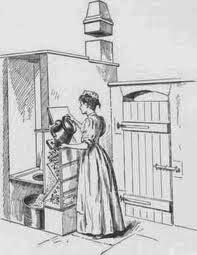
A number of hospitals had indoor water closets of some sort. They night have a rudimentary flush mechanism activated by pulling the chain to a cistern. The water carried the waste directly into a sewer, but there was nothing to keep noxious odors and gases from coming back up into the water closet. A hospital in Central Park in New York City had water closets on all the floors, but the building was so tall that the pressure was insufficient to get water for flushing to the upper floors.

Some hospitals had toilets that had to be flushed by using a bucket of water. Since that water usually had to be hauled from a distance, the facilities were not flushed as often as they should have been. Another variety, especially popular in Philadelphia hospitals, was a long, slightly slanted zinc trough. The trough had a cover with a number of seat holes. At the upper end was a faucet that could be turned on to flush the waste down a sewer hole at the other end. Ideally the water was always on to keep the trough clean, but, practically, this used too much water, so waste and odor accumulated between periodic flushes.

An indoor latrine did little good if the soldiers did not know how to use it. the patients at the Gordon Hospital in Nashville, Tennessee, in November 1861 used the water closets like a trash can, throwing in paper, sticks, cloth, and other rubbish. Not surprisingly, the drainpipes plugged up and filthy sewage overflowed the hospital to such an extent that the patients had to be moved out and the hospital closet and thoroughly cleaned.

The efforts of the U.S. Sanitary Commission in the Union army, as well as medical inspectors, surgeons, and army officers on both sides, led to considerable improvement in sanitation as the war progressed. It was evident that well-disciplined regiments, with properly prepared and used latrines, had much less sickness than unsanitary regiments.

From: The Encyclopedia of Civil War Medicine

Latrines

 By Glenna R. Schroeder-Lein

Latrines were commonly called "sinks" by soldiers North and South during the Civil War. Improper preparation of latrines, and the failure of some soldiers to use them, caused great discomfort and much disease in virtually all the armies at times.

The common sink was a trench 10 to 12 feet long, 1 to 2 feet wide, and 6 to 8 feet deep. A crotched stick was placed at each end to hold a pole that functioned as a seat. Improvements on the conventional sink included boards with holes placed over the trench and, i the union Army of the Cumberland, board platforms with kegs or cracker boxes for seats. Each day six inches of dirt was supposed to be shoveled into the sink to cover the waste. Ideally. carbolic acid or chlorinated lime would also be added to deodorize and sanitize the area. Some regimens surrounded the sink with brush to provide minimal privacy. When the sink was filled to within one and a half to two feet of the edge, it was supposed to be filled in and a new sink dug. Each regiment was supposed to have a sink on the left and right ends of the camp as well as a third sink for the officers.

Sinks were the source of a variety of problems. Early in the war many regiments failed to construct sinks at all. Soldiers from rural areas were used to using convenient bushes and continued the practice in camp. This habit led to filthy, offensive, and malodorous sites that quickly caused diseases such as typhoid fever, diarrhea, and dysentery. Even regiments that dug sinks could have similar problems if the officers did not enforce discipline and insist that the men use the sinks. One probably effective punishment, applied in some Union camps, was to force the offender to wear a barrel with his head protruding over the top and excrement piled under his nose.

Some sinks were poorly maintained. Soldiers in charge failed to cover the deposits with dirt every day. Men who were lazy or too ill to control themselves missed the sink, producing nasty areas around the edges of the latrine. The offensive smell caused some soldiers to avoid the sinks while others sought the bushes because of modesty. These actions only contributed to the problem.

Even a sink that was well maintained might be poorly located, in a place where the sewage seeped, drained, or overflowed into the camp water supply. Wells and streams were easily polluted with germs that caused intestinal diseases. Some latrines were located close to camp kitchens or cooking areas, where flies spread disease from the excrement to the food. In October 1861, the surgeon of the Third Tennessee Regiment (Confederate) complained that the men of the Eighteenth Tennessee were digging a sink right next to his regimental hospital. He protested that the latrine would contribute to the spread of disease and undo all the progress he had made toward cleanliness in his regiment.

From: The Encyclopedia of Civil War Medicine

Image: Latrine, Camp Sumner, Andersonville, Georgia, circa 1863


Tuesday, August 20, 2013

Lice

LICE
By Glenna R. Schroeder-Lein

Lice, small insects that thrive in dirty places, were ubiquitous in the clothes and on the bodies of Civil War soldiers, North and South. Although soldiers with high standards of personal cleanliness might delay getting lice, sooner or later everyone from the lowliest private to the highest general suffered their presence.

The initial discovery of lice on one's person embarrassed many soldiers, who sought to rid themselves of the pests in private. However, most soldiers soon realized that lice were a universal problem, and "skirmishing" for "graybacks" became a communal social event as soldiers sat around in a group examining their clothing, removing the vermin, and squishing them. At time;s, bored soldiers held "vermin fairs" and louse-jumping contests to see whose insect hopped the farthest.

Skirmishing for lice provided temporary and partial relief, as did the rare opportunity to acquire a new uniform and burn one's old clothes. The only lasting way to get lice out of apparel was to boil the clothes in water, preferably with a little salt. Most soldiers had or took few opportunities to boil their clothes or bathe frequently, so lice remained a constant problem.

Civil War soldiers saw lice as a nuisance, not as spreaders of disease. Lice transmit typhus, but surprisingly few cases of typhus were reported during the war. However, the lice caused unpleasant itching, and the resultant scratching of dirty skin led to numerous skin infections.

From: "The Encyclopedia of Civil War Medicine"

Share

Facebook Twitter Delicious Stumbleupon Favorites